The Bioelectric Self
A University reunion triggered the most unusual energetic event

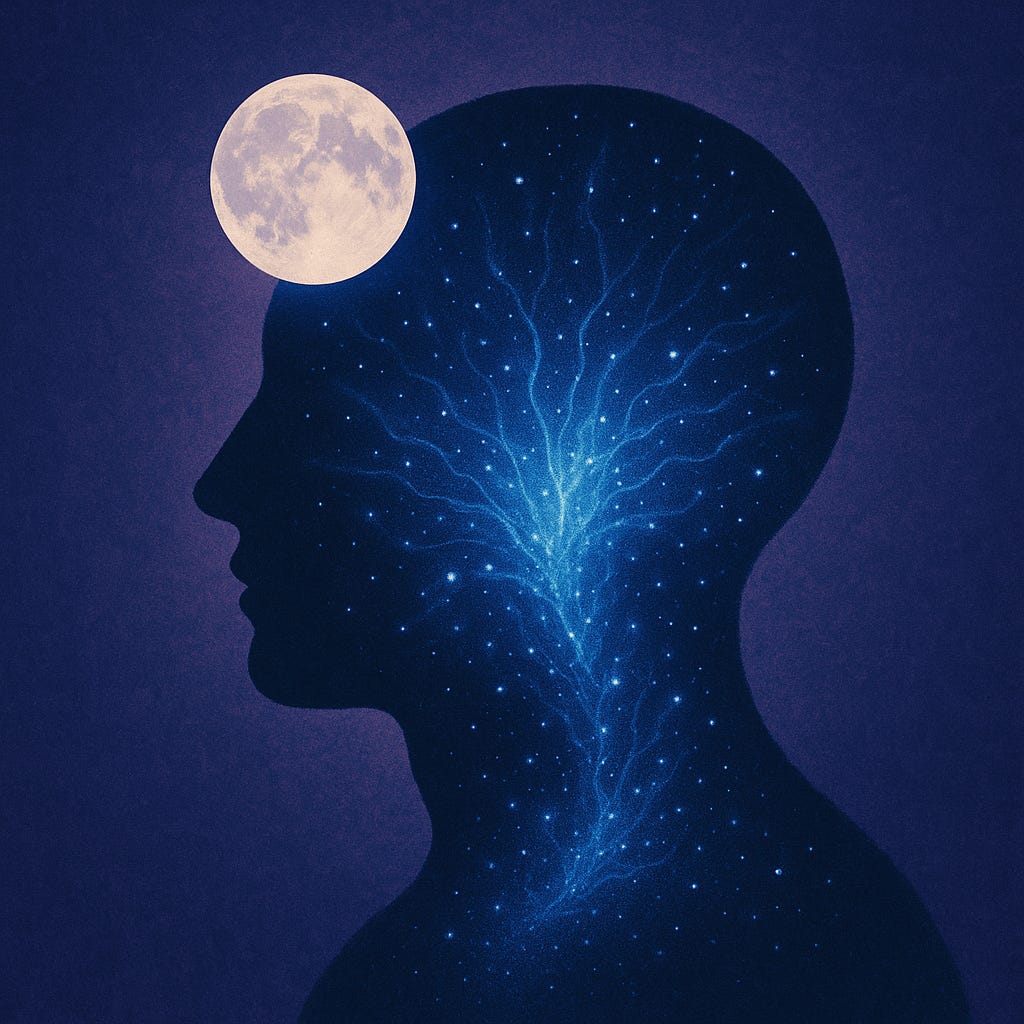
Some of us have always felt more: the weight in a room, the quiet ache in someone’s words, the shimmer of energy before sleep. We’ve been told it’s too much, too emotional, too unscientific. The Bioelectric Self offers another possibility, that these sensations are real, that they are measurable, and that by naming them, we reclaim part of our humanity.
It began with a gathering, not so much the event itself as the density of it. The room was filled with people I had once known, their histories vibrating in the air. Conversation floated on the surface while unspoken things travelled underneath: ambition, comparison, the ache of what might have been.
I entered with a flicker of hope and a quiet knowing that it would not be simple. These were the people who had first taught me about the body through anatomy and textbooks, but not about the subtler ways bodies speak. Medicine had trained us to measure, not to feel; to look for pathology, not for pattern. Yet that night, every cell in me was listening, not to words but to charge.
Some call this sensitivity; I know it now as a form of intelligence. An empathic body is a porous one. It registers shifts in tone, temperature, and tension. It notices coherence and discord the way some people notice colour. For years I thought this meant I was fragile, over-responsive, or too emotional. The truth is that empathy is simply biology with its antennae intact. When that sensitivity becomes conscious, when we stop absorbing and start translating, it evolves into what I call the empowered empath: someone who can stand in the storm, feel every current, and still remain centred. It isn’t fragility; it’s a superpower born of coherence.
Empowered empaths often emerge through difficulty. Many of us are shaped by moments that forced us to understand what we were feeling and why. I’m sure some people are born attuned in this way, but I wasn’t. Mine was learned the hard way—through endurance, reflection, and the slow work of rebuilding trust in my own body. It came from learning where I ended and others began, from transforming sensitivity into self-knowledge and compassion into boundary.
That night the air felt heavy, the field crowded. Familiar faces and familiar stories filled the room, yet everything seemed slightly off tune. I could feel it all—the nerves, the striving, the tenderness hidden beneath performance. When I finally left, I felt emptied, not sad exactly, just stripped back. Definitely lonely. Unseen. The moon hung full above the city, pulling the tides within me as surely as it pulls the sea. I went to bed feeling distant from the world yet somehow solidified in who I am. Who i have become.
In the early hours, between sleep and waking, something happened. A bright light, fizzing around me, from me, it emanated from beneath the skin, not heat and not dream, but light, fine as static and soft as mist.
I don’t know what that light was, but I know how it felt. It wasn’t outside me; it was of me, a language my body spoke before I had words for it. I think it was the moment something old began to dissolve, the cells releasing a story they no longer needed to carry.
Whatever it was, it felt like evolution, the nervous system remembering something ancient, the mitochondria adjusting their frequency, the self turning itself over to something truer.
In modern biology, this could be called a biophotonic release, light emitted as mitochondria metabolise stored energy and information. Researchers such as Fritz-Albert Popp have studied this for decades, showing that all living organisms emit ultra-weak photons in rhythmic patterns, a kind of cellular language. Michael Levin’s work at Tufts expands this understanding: his research on bioelectric fields demonstrates that tiny voltage gradients between cells form a code guiding growth, regeneration, and repair. Energy, in this view, is not separate from information; it is the architecture through which life organises itself.
Long before we could measure any of this, Albert Szent-Györgyi, Nobel laureate and father of modern biochemistry, wrote that “life is too rapid to be explained by slow chemical reactions.” He was pointing to the same mystery, that living systems move at the speed of light.
The ancients described it differently but no less precisely. Chinese medicine called it qi. The Vedas spoke of prana. Yogic texts described kundalini, the rising of life force through the body as awareness clears obstruction. Different maps describe the same terrain: energy reorganising itself into coherence. Whether we call it voltage, photon flow, or life force, it is the same current—the body translating experience into signal, matter into meaning, emotion into light.
Since that night, an immense fatigue has followed, a deep, bone-tiredness that feels more existential than physical. It doesn’t correspond to my biometrics; my Oura and readiness scores remain in the nineties. This exhaustion seems to live somewhere subtler, perhaps in the same energetic architecture that briefly illuminated me. It feels less like depletion and more like integration, as if my system is quietly recalibrating after shedding an old vibration.
In the days that followed, the fatigue settled in like a tide going out. It wasn’t the kind that sleep or supplements could touch. My body felt heavier, slower, as though it was busy with something invisible. The weariness wasn’t depletion; it was assimilation, the long exhale after a surge of light.
Biologically, the mitochondria had likely spent enormous energy recalibrating. After any burst of heightened signalling—whether emotional, electrical, or spiritual—the body must re-establish equilibrium. Cells down-regulate, hormones rebalance, neurotransmitters clear. The physiology of recovery mirrors the psychology of it: what feels like emptiness is often restoration.
Energetically, traditions have always described this as the integration phase. In Chinese medicine it would be the return of yin after a surge of yang. In yogic systems, it is the grounding of prana after kundalini rises, the descent of light back into matter. Every system recognises that expansion demands rest, that illumination must be embodied to become wisdom.
So I stopped trying to correct the fatigue. I let it be the medicine. I walked slowly, ate simply, and spent time in sunlight without purpose. I noticed that when I softened around the tiredness rather than resisting it, my body began to find its rhythm again.
Perhaps this is what healing really looks like—not a straight ascent, but a pulse. Charge and rest, light and dark, eruption and integration. The luminous moment was only half the story; the stillness that followed was the other half.
The body, it seems, knows how to complete its own sentences. We only need to listen long enough for the light to translate itself into form.
Perhaps you have felt something like this: a shimmer in stillness, a sudden brightness that has nothing to do with lightbulbs or sunlight. Maybe it came during loss, or awe, or quiet fatigue, when everything familiar loosened for a moment and you sensed something rearranging itself inside you.
What if those moments are not anomalies but conversations—your body speaking in its oldest language, translating experience into current, coherence, and release?
You don’t need to seek them. Just notice the subtle fields: the warmth in your chest after truth, the tingling in your skin when you are seen, the deep tiredness that follows emotional honesty. These too are expressions of light.
Perhaps this is what healing really looks like—not a straight ascent, but a pulse. Charge and rest, light and dark, eruption and integration. The luminous moment was only half the story; the stillness that followed was the other half.
The body, it seems, knows how to complete its own sentences. We only need to listen long enough for the light to translate itself into form.
The moon has always mirrored this rhythm. It waxes, wanes, and begins again, governing not only the tides but the subtle waters within us. On the night of that full moon, something in me aligned with its pull—expansion giving way to release, brightness softening into rest. The same field that moves the oceans was moving through my cells, asking me to empty, to integrate, to begin again.
I no longer dismiss that as coincidence. As a Cancer sun and moon with Sagittarius rising, my body and my nature have always been tuned to both depth and perspective,
one half ocean, one half sky. For years I downplayed that sensitivity, afraid it would make me seem unscientific or sentimental. But the longer I study biology, the more I see how the lunar and the cellular mirror each other. The moon’s cycles are written into our hormones, our circadian clocks, and the water that makes up most of us.
So now I pay attention. When the moon is full, I expect to feel more—more awake, more porous, more reflective. I no longer pathologise that awareness; I see it as data, as dialogue, as coherence between my inner tides and the wider cosmos.
Perhaps you have felt something like this: a shimmer in stillness, a sudden brightness that has nothing to do with lightbulbs or sunlight. Maybe it came during loss, or awe, or quiet fatigue, when everything familiar loosened for a moment and you sensed something rearranging itself inside you.
What if those moments are not anomalies but conversations—your body speaking in its oldest language, translating experience into current, coherence, and release?
You don’t need to seek them. Just notice the subtle fields: the warmth in your chest after truth, the tingling in your skin when you are seen, the deep tiredness that follows emotional honesty. These too are expressions of light.
The medicine is already within you. Listen for it. It will find its way to the surface when the time is right.
Beautifully written piece. My senses were tingling like an evening raga playing in a Sitar